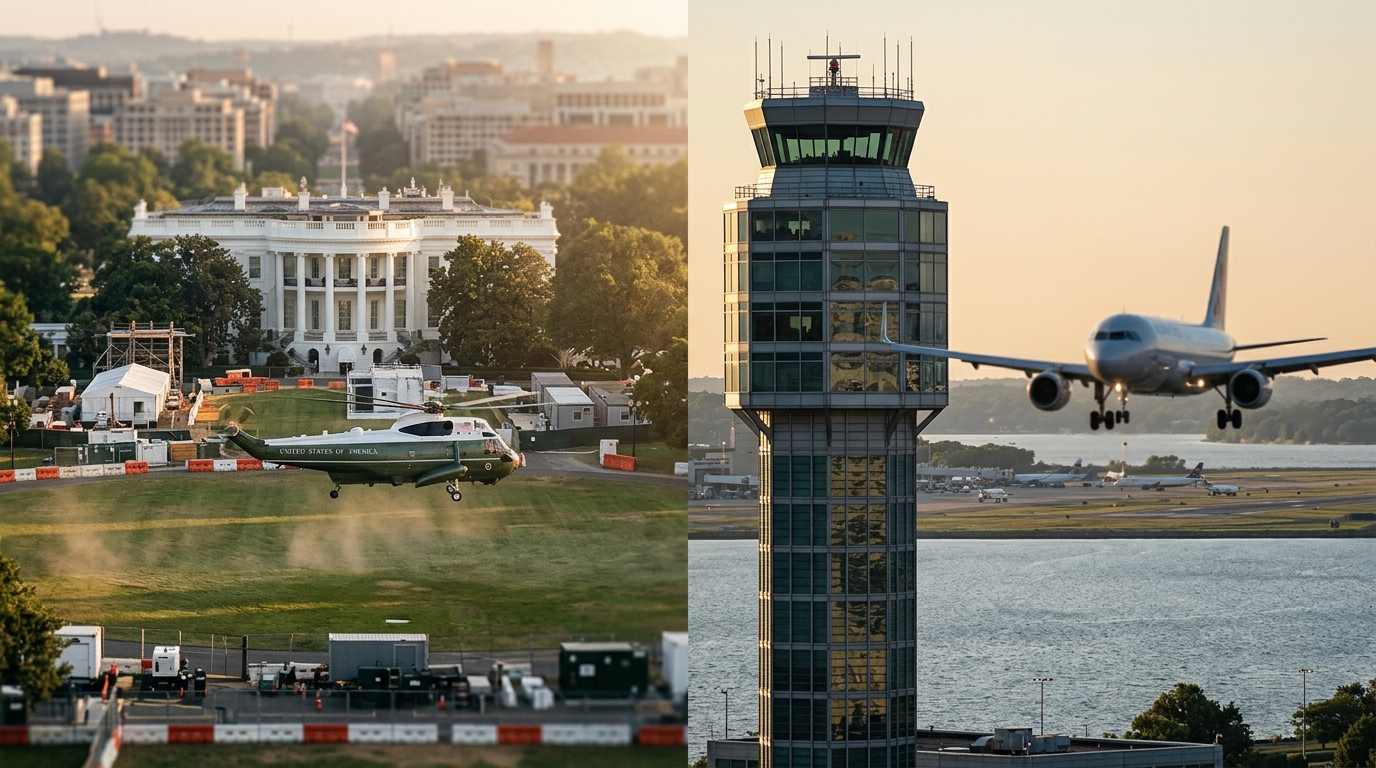
A critical safety incident involving President Donald Trump's Marine One helicopter and commercial air traffic at Ronald Reagan Washington National Airport (DCA) has drawn sharp scrutiny, with federal investigators pointing to ongoing White House construction as a contributing factor. The National Transportation Safety Board (NTSB) found that air traffic controllers didn't halt commercial flights when the presidential chopper lifted off from a temporary site at the Ellipse in early August, a move that potentially jeopardized air safety over the nation's capital. This wasn't just a simple miscommunication; it highlighted deeper issues that had been brewing for a while. Just a week before the August 4 incident, air traffic controllers and Marine One pilots had actually met to hash out ongoing communication problems, but couldn't nail down a solution (WTOP). The fact that a commercial jet and the presidential helicopter were allowed to be in the air simultaneously appears to go against established safety protocols, especially those tightened after a tragic mid-air collision near DCA last year that claimed 67 lives (WTOP).
Air traffic controllers didn't stop commercial flights when President Trump's helicopter took off from the Ellipse, despite prior warnings about communication issues.
### The Ellipse Departure and Construction Complications President Trump's usual departure point from the South Lawn of the White House was unavailable due to extensive construction. This forced Marine One to use the Ellipse, a public park just south of the Executive Mansion, as a temporary helipad. While the Ellipse has been used for presidential departures before, the NTSB's preliminary findings suggest that the temporary nature and the surrounding construction created an environment ripe for missteps. Investigators are digging into how the shift in departure location, combined with the ongoing construction noise and activity, might have complicated communication protocols between the White House Military Office, the Federal Aviation Administration (FAA), and air traffic control at DCA. The standard procedure for presidential movements involves a significant airspace restriction, ensuring no other aircraft are in the vicinity during take-off or landing. The breach of this protocol, particularly with a commercial flight in the air, raises serious questions about coordination and adherence to safety guidelines. ### Prior Warnings Went Unheeded The NTSB's report also shed light on a crucial detail: the communication breakdown wasn't a sudden occurrence. A full week before the August 4 incident, air traffic controllers in the Washington area held a meeting with Marine One pilots specifically to address concerns about communication failures. Despite this proactive discussion, the meeting concluded without a concrete resolution or a clear plan to prevent future issues. This lack of resolution directly preceded the dual take-off incident, underscoring systemic problems rather than just an isolated error (WTOP). The stakes for air traffic safety in the DMV region couldn't be higher. Ronald Reagan Washington National Airport is one of the busiest airports in the country, situated in a complex airspace that includes numerous military and government flight operations. The proximity to the White House, the Pentagon, and other critical federal facilities means that any lapse in air traffic control or presidential security protocols has widespread implications for both national security and the thousands of daily commuters and travelers using DCA. Residents rely on the meticulous coordination of these agencies for safe skies. ### Examining the Aftermath and Future Implications The NTSB's investigation is ongoing, and a full report is expected to detail all contributing factors and recommend specific actions to prevent similar incidents. This incident highlights the delicate balance between security needs, air traffic management, and the practicalities of operating in a constantly evolving environment like downtown Washington, D.C. The fact that White House construction played a role underscores how seemingly unrelated factors can cascade into significant safety concerns. For DMV residents, particularly those who live near DCA or frequently fly out of the airport, this incident is a stark reminder of the complexities of air traffic control in such a sensitive area. It prompts a renewed focus on ensuring that all agencies involved — from the FAA to the White House Military Office — are operating with seamless communication and strict adherence to safety protocols. We'll be watching closely for the NTSB's final recommendations and how federal agencies plan to implement them to safeguard our skies.