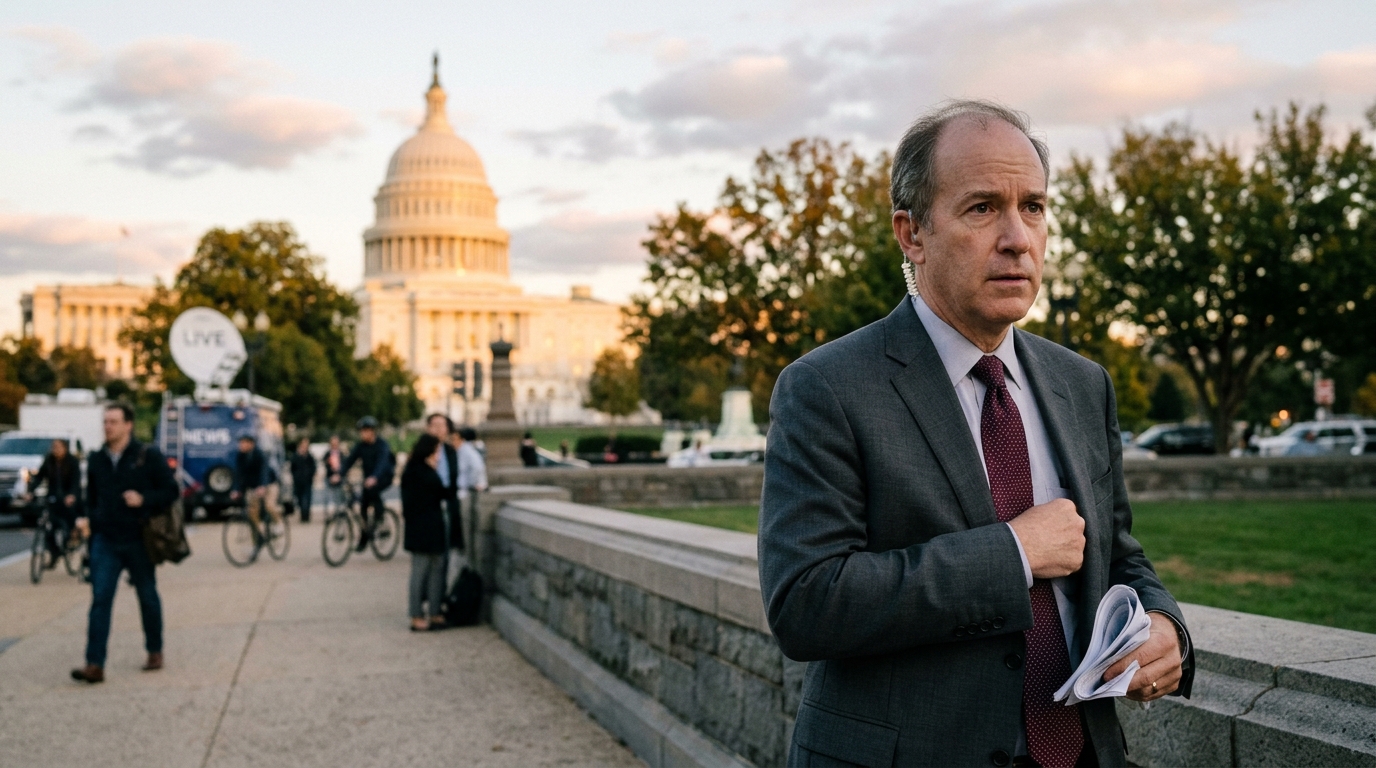
Imagine the sheer volume of digital breadcrumbs we leave behind every day, especially on our phones. Now, imagine those breadcrumbs leading foreign adversaries right to the gates of the White House, or perhaps even inside the CIA's top-secret headquarters. That's the chilling scenario three congressional Democrats are warning about, revealing that new data protection rules designed to shield sensitive U.S. government locations from foreign data brokers have some glaring omissions right here in the nation's capital. The Biden administration spent nearly a year developing regulations aimed at stopping hostile nations from buying commercial location data collected from cell phones near critical federal sites. These rules, which officially went into effect in April 2025, were supposed to be a crucial shield against espionage. But according to a letter issued Thursday by Sens. Ron Wyden of Oregon and Martin Heinrich of New Mexico, and Rep. Sara Jacobs of California, key locations like the White House, the U.S. Capitol, and the CIA's headquarters were inexplicably left off the list of 736 designated sensitive sites.
"The sale of Americans’ location data by data brokers poses a serious threat to U.S. national security, particularly when data about U.S. government employees is sold to foreign governments," — Sens. Ron Wyden (Oregon), Martin Heinrich (New Mexico), and Rep. Sara Jacobs (California) (WTOP)
### Closing Critical Security Gaps The lawmakers didn't mince words in their letter to Trump administration officials, stating that such commercially available data "can reveal sensitive information that can be exploited for espionage purposes." They urged the administration to fix these oversights promptly. Their recommendations include creating a comprehensive "protection zone" that encompasses the entire Washington, D.C. region, rather than relying on a piecemeal list of individual buildings. They also pressed for an expansion of the list of countries barred from acquiring data on Americans. This isn't just about abstract national security; it's about the daily lives and digital footprints of thousands of federal employees, contractors, and visitors across the DMV. For those working in or around these critical D.C. locations, the failure to include the White House or Congress means their cell phone data could still be bought and exploited by foreign entities, potentially compromising operations or revealing personal patterns that could be used for targeting.
The new rules, effective April 2025, broadly ban selling location data on over 1,000 American devices to countries like China, Russia, and Iran, but missed critical U.S. government sites.
### The Peril of Commercial Data Sales Data brokers routinely collect and sell vast amounts of personal information, including precise location data, often without users' explicit knowledge or consent. While traditionally used for targeted advertising and market analysis, governments worldwide have increasingly leveraged these datasets for intelligence gathering and law enforcement. Foreign spy agencies could easily use this information to map the movements and routines of U.S. government personnel, creating significant vulnerabilities. The rules, which you can read more about in this Associated Press report on Biden's executive action, were specifically designed to curb data sales to countries like China, Russia, Iran, North Korea, Cuba, and Venezuela. While they broadly ban selling location data from more than 1,000 American devices to these nations, the specific "designated sites" were meant to offer an extra layer of protection, making it illegal to sell even a single device's data if it was captured there. ### How the Gaps Were Discovered The rules identify protected locations only by GPS coordinates. Senator Wyden's staff, working alongside the Congressional Research Service, undertook the painstaking effort of analyzing these coordinates to determine exactly which U.S. government facilities were included and which were left out. This analysis brought the critical omissions to light. When asked for comment, a spokesperson for the U.S. Department of Justice declined to provide a statement, and the Office of the Director of National Intelligence (ODNI) did not respond to inquiries. The silence from these key agencies only underscores the urgency of the issue raised by the lawmakers. For DMV residents, particularly those working in federal government roles, this warning is a stark reminder about personal data security. It highlights the ongoing challenge of protecting sensitive information in an increasingly connected world. As lawmakers push for a comprehensive D.C.-wide protection zone, it's crucial for individuals to be aware of their digital footprint and for the administration to act swiftly to close these dangerous gaps. We'll be watching to see how the administration responds to these urgent calls for stronger protections across our region. For more information on local government services, you can visit DC.gov.
📍 Local Resources
Federal Employee Assistance Program (EAP)
Confidential counseling and referral services for federal employees and their families dealing with personal and work-related issues, including stress from security concerns.
A public interest research center in Washington, D.C., focusing on privacy, open government, and civil liberties. Offers resources and information on data protection.