Virginia General Assembly Rejects Amended Collective Bargaining Bill for Public Workers
Share this article
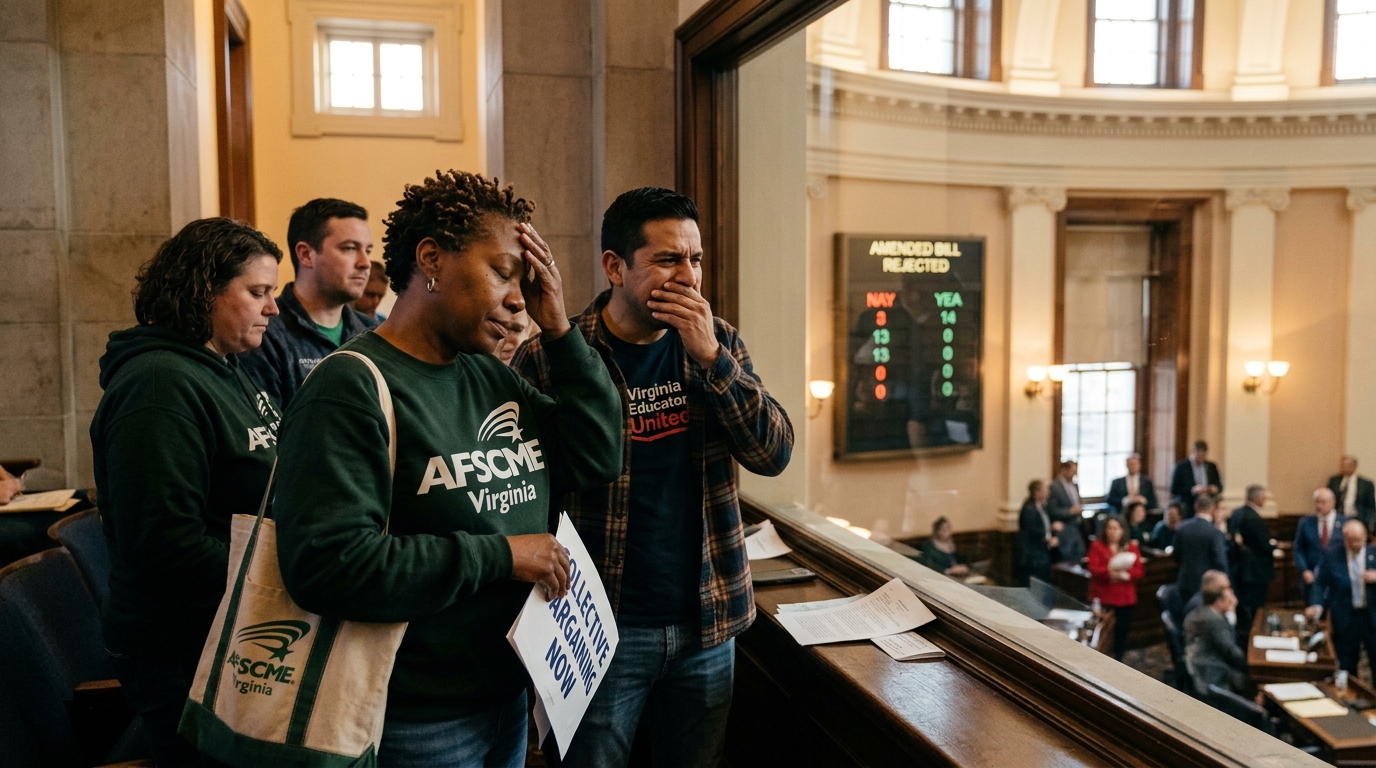
RICHMOND, VA – The Virginia General Assembly has rejected an amended bill aimed at expanding collective bargaining rights for public sector employees, a legislative move that originated with Fairfax County legislators. The rejection occurred during a reconvened session, marking a significant setback for labor advocates in the Commonwealth.
Governor Abigail Spanberger (D) had proposed a substitute version of the original collective bargaining bill. However, this amended proposal failed to garner sufficient support from the General Assembly, leading to its ultimate defeat [1]. The decision underscores the ongoing legislative hurdles surrounding public employee labor rights in Virginia.
Legislative Setback for Public Workers
The rejection of the amended bill represents a key moment in the continuing debate over collective bargaining in Virginia. For public employees, the ability to collectively bargain provides a structured process for negotiating wages, benefits, and working conditions with their employers. Proponents argue it empowers workers and ensures fair treatment, while opponents often cite concerns about budget impacts and governmental autonomy.
The legislative effort, initially advanced by representatives from Fairfax County, sought to build upon existing state law. Virginia traditionally maintained a ban on collective bargaining for public employees until a 2020 law granted local governments the option to establish such agreements. This specific bill aimed to refine and potentially broaden those provisions, particularly impacting localities like Fairfax County, which has a substantial public workforce.
Understanding Collective Bargaining in Virginia
For decades, Virginia was one of the few states that largely prohibited public sector collective bargaining. The landscape began to shift with a 2020 law, codified as Virginia Code § 40.1-57.2, which granted local governments the discretion to adopt ordinances allowing their employees to collectively bargain. This change opened the door for individual cities and counties to decide on the matter, rather than a statewide mandate.
Since 2020, several Virginia localities, including Fairfax County, have explored or moved towards implementing collective bargaining frameworks. The bill rejected by the General Assembly was an attempt to either clarify or expand the scope and implementation of these rights statewide, or at least solidify them for specific regions. The Governor's substitute likely aimed to bridge differences between various legislative factions, though ultimately unsuccessfully.
Governor's Amendments and the Reconvened Session
The legislative process in Virginia often involves several stages, including a reconvened session where the General Assembly reviews bills amended or vetoed by the Governor. During this session, legislators consider the Governor's proposed changes, known as "substitutes," which aim to modify a bill's language or intent to make it more palatable or align it with executive priorities. The rejection of Governor Spanberger's substitute indicates that her proposed changes were not enough to secure passage, or that fundamental disagreements over the bill's core principles persisted among lawmakers.
The Governor's office, as detailed on the official Virginia government website, plays a crucial role in the legislative process, including proposing amendments. This particular instance highlights the legislative checks and balances, where the General Assembly ultimately holds the power to accept or reject gubernatorial modifications to legislation.
Implications for Fairfax County and Beyond
For Fairfax County, a populous jurisdiction with a significant number of public employees, the defeat of this bill means that efforts to expand or standardize collective bargaining rights will need to find a different path. Fairfax County legislators have been prominent in advocating for enhanced worker protections and negotiation capabilities, reflecting the county's generally progressive political leanings and its large, diverse workforce.
The outcome could also influence future legislative strategies for labor unions and public employee associations across the Commonwealth. Organizations advocating for public workers often monitor such legislative actions closely, as they directly impact their members' ability to negotiate for better terms of employment. Data from sources like the Virginia Public Access Project (VPAP) frequently highlight the political contributions and lobbying efforts surrounding labor legislation, underscoring the deep interest in these debates.
The Path Forward for Labor Advocates
The rejection of the amended collective bargaining bill does not necessarily signal the end of efforts to expand public employee rights in Virginia. Advocates may pursue alternative legislative strategies in future sessions of the Virginia General Assembly, focusing on different approaches or seeking to build broader bipartisan consensus. Local governments also retain the option to enact their own collective bargaining ordinances, a power granted by the 2020 law. Fairfax County's own Department of Human Resources continues to manage employee relations within the existing legal framework.
The legislative process is often incremental, and proponents of collective bargaining are likely to continue their advocacy, potentially focusing on education, grassroots organizing, and supporting candidates who champion their cause in upcoming elections. The debate over the scope of public sector labor rights remains a persistent feature of Virginia's political landscape.
📍 Local Resources: Virginia Legislative Information
Official website for legislative information, bill tracking, and legislator contact details.
Provides information on labor laws and regulations in Virginia, though specific to private sector for many collective bargaining issues.
Non-partisan organization providing data on money in Virginia politics, including legislative voting records and campaign finance for informed civic engagement.
Explore more on this topic
Related Stories
Councilmember Janeese Lewis George Urges Caution on Waymo Legislation, Citing DC's Jobs Crisis
Ward 4 Councilmember Janeese Lewis George has urged the DC Council to pump the brakes on Waymo legislation this year, warning that rushing autonomous vehicle laws could worsen the city's "jobs crisis" by displacing workers. She emphasizes the need to prioritize safety and worker support alongside technological advancement.
Ousted Board of Appeals Chair Sues Howard County Council, Office of Law
Howard County's ousted Board of Appeals chair has filed a lawsuit against the County Council and the Office of Law, initiating a significant legal challenge within the local government structure. This action highlights internal administrative disputes and brings the county's appointment and oversight processes into public scrutiny.