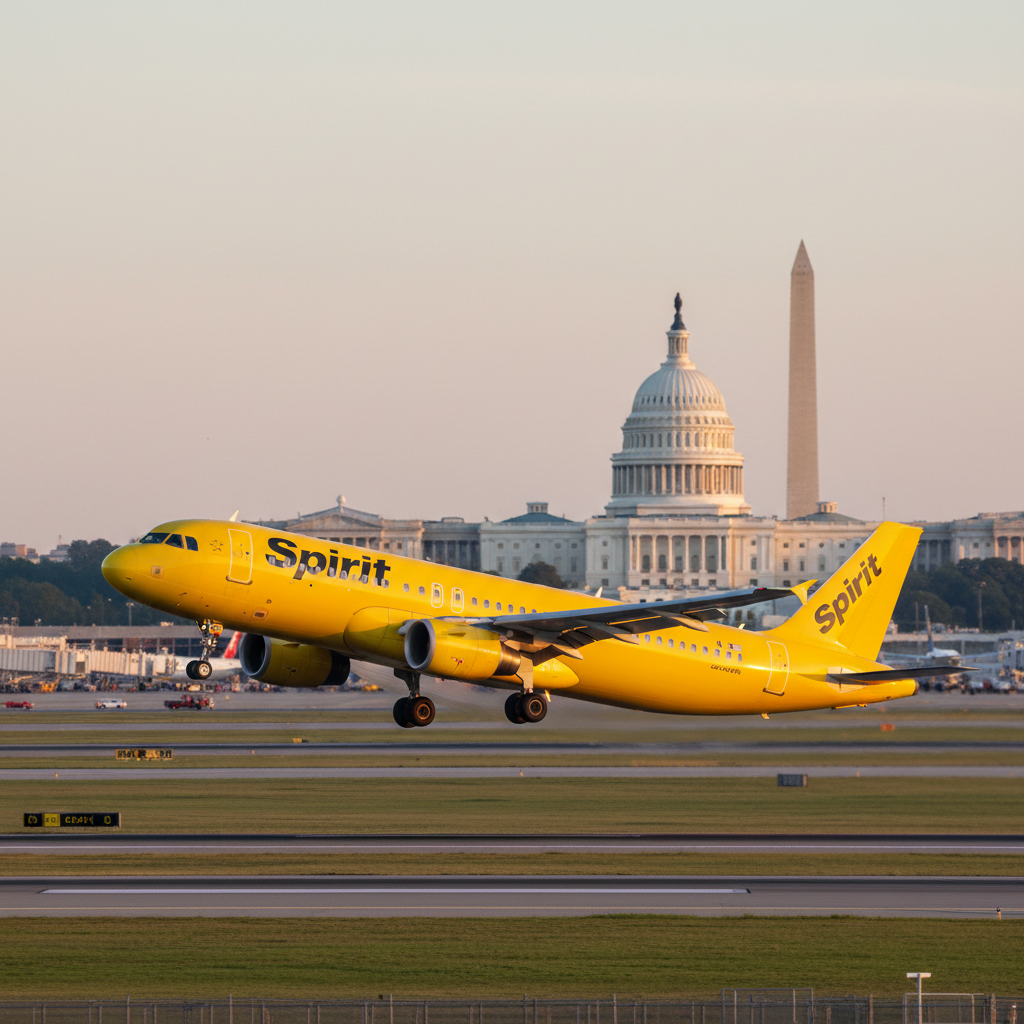
The landscape of air travel for residents across the Washington metropolitan area often shifts with the winds of economic and political discourse. A recent statement from former President Donald Trump, suggesting a desire for a buyer to emerge for Spirit Airlines, has captured attention, particularly given the carrier’s significant footprint across the region’s airports. The comments, made during an appearance on CNBC's "Squawk Box," underscore a broader conversation about the future of a budget airline that many DMV residents rely upon for affordable travel options. "I think I'd love somebody to buy Spirit, as an example," Donald Trump told CNBC's "Squawk Box" (CNBC). This remark, reported by CNBC under the headline that Trump also pondered "maybe" government assistance for the "struggling" airline, casts a spotlight on the carrier's operations and its role in the competitive aviation market. For the countless commuters and vacationers departing from Ronald Reagan Washington National Airport (DCA), Washington Dulles International Airport (IAD), and Baltimore/Washington International Thurgood Marshall Airport (BWI), the future of Spirit Airlines holds tangible implications. Spirit Airlines has carved out a niche in the DMV, offering a no-frills, low-cost model that has appealed to a wide demographic. Its presence at BWI, IAD, and DCA allows residents from Montgomery County to Prince George's County, and from Arlington to Fairfax, to access a network of domestic and international destinations. An acquisition, or indeed any form of government intervention, could profoundly reshape the competitive dynamics of these busy air hubs.
Spirit Airlines maintains a significant operational presence across the DMV's three major airports, serving a large base of budget-conscious travelers.
The prospect of an airline acquisition, especially one involving a carrier as prominent as Spirit in the DMV, raises a multitude of questions for local travelers. Would routes be consolidated or expanded? What would become of the fare structures that have made Spirit a go-to for many? The answers, while speculative at this juncture, carry weight for individuals planning family visits or business trips on a budget. Any major shift could alter the carefully balanced ecosystem of air travel options available to the region’s diverse population. While the former President's comments were a singular observation rather than a policy directive, they highlight the ongoing challenges and strategic considerations within the airline industry. The Department of Transportation (DOT) continuously monitors the health of U.S. carriers, ensuring fair competition and consumer protection. Any discussion of government assistance or a major industry consolidation naturally falls within the purview of federal oversight, which could have direct bearing on the services available at Reagan National and Dulles International. For DMV residents, the statement serves as a reminder of the fluidity of the travel market. Whether through an eventual acquisition or other means, the future trajectory of Spirit Airlines will undoubtedly be watched closely by those who frequent its gates and depend on its services. The implications of such a high-profile suggestion, even if informal, could ripple through the region’s aviation sector, prompting both industry leaders and policymakers to consider their next moves.
📍 Local Resources for Air Travelers
U.S. Department of Transportation (DOT) Air Travel Consumer Protection
Provides information and assistance for air travelers regarding consumer rights, airline service quality, and complaint resolution.
Manages and operates Ronald Reagan Washington National Airport (DCA) and Washington Dulles International Airport (IAD), offering flight information, parking, and traveler services.