How to Vote in DC, Maryland, and Virginia: A Complete 2026 Guide for DMV Residents
Share this article

Here’s your straight-talk 2026 voter guide for the District, Maryland, and Virginia—what to do today to make sure your ballot counts. I’ll show you where to confirm your registration, what ID (if any) to bring, when and how early voting works, how to handle mail ballots, and exactly what to do if you hit a snag at the polls.
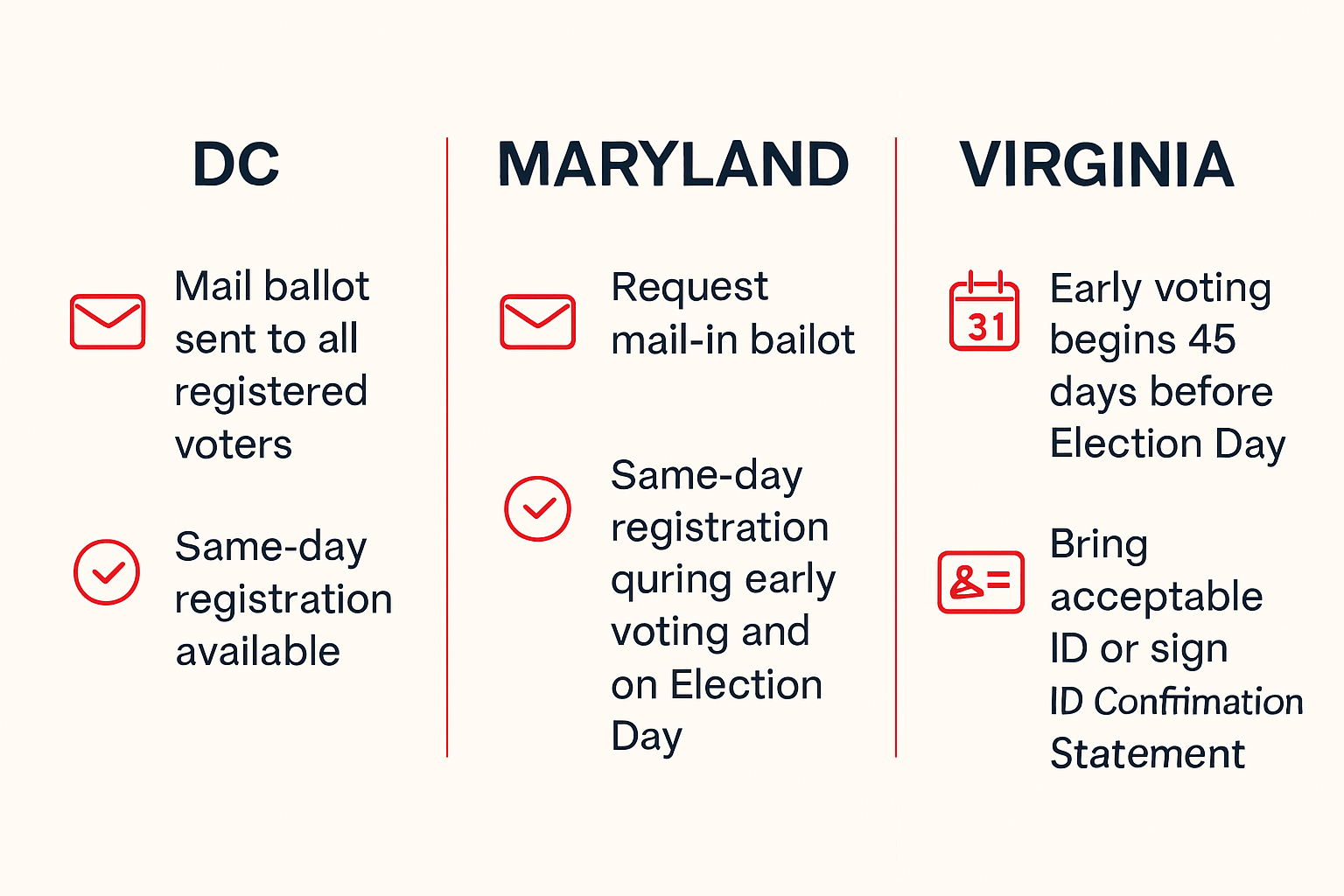
Quick Answer: Check your registration now, pick a voting method, and stick to your state’s rules. DC mails every registered voter a ballot and offers same‑day registration. Maryland lets you register the same day during early voting or on Election Day with proof of residency. Virginia starts early voting 45 days before Election Day and lets late registrants cast a provisional ballot. If anyone tries to turn you away, ask for a provisional ballot and get help from your local election office on the spot.
Start here: verify your status, preview your ballot, and choose your plan
Lock in your plan early. Your first stop is your state’s official portal—these pages are live year‑round and update for each election:
- District of Columbia: Use the DC Board of Elections tools to verify your voter registration and election information, including vote centers, early voting, and mail ballot details.
- Maryland: The State Board of Elections’ Voter Services portal lets you look up your registration, sample ballot, and polling place.
- Virginia: The Department of Elections Citizen Portal covers registration status, polling places, and absentee options.
With your info confirmed, decide how you want to vote: early in person, in person on Election Day, or by mail. Each option has different cutoff times for registration and mail processing, and each state handles ID and same‑day options differently. The sections below break it down.
If you have a disability, are an older voter, or need language assistance, each state provides accessible equipment and assistance rules. Start with your official resources: DC Board of Elections, Maryland State Board of Elections, and Virginia Department of Elections.
District of Columbia: how to vote the DC way
Registration: you can register up to and on Election Day
DC keeps registration simple. You can register online, by mail, or in person. DC also offers same‑day voter registration during early voting and on Election Day; bring acceptable proof of residence if you’re registering on the spot. See DCBOE’s registration info and acceptable documents via the DC Board of Elections.
ID rules: generally not required to vote a regular ballot
Most DC voters do not need to show ID to vote in person. If you’re registering for the first time and did not provide required identification details when you registered, you may be asked to present documentation under federal Help America Vote Act rules. DC lists what qualifies for proof of residence if you register at the polls; check DCBOE’s guidance on the official site.
Early voting: vote centers open before Election Day
DC operates Early Vote Centers across the city. Hours and locations are posted before each election on the DCBOE site. You can go to any open Early Vote Center in the District, not just one tied to your address. Watch DCBOE’s election calendar and early voting pages at dcboe.org for dates and locations as each election approaches.
Mail ballots: DC mails a ballot to every registered voter
DC mails a ballot to every registered voter ahead of each election. You can return it by mail, at a secure drop box, or at any vote center. According to DCBOE, mail ballots must be postmarked by Election Day and received by the 10th day after the election to count; always verify the posted deadline for your election on the DCBOE website. Track your ballot’s status and find drop box locations through DCBOE’s voter services pages.
If you prefer to vote in person, you can still bring your mailed ballot to a vote center and surrender it, then vote a standard ballot in person. DCBOE explains the process on the official site.
If a problem comes up
- Provisional ballot: If there’s a question about your eligibility, ask for a provisional ballot. DC explains provisional voting and follow‑ups on the Board of Elections site.
- Assistance and accessibility: DC provides accessible machines and allows assistance for voters who need help. See DCBOE’s accessibility information at dcboe.org.
Maryland: early voting everywhere, plus same‑day registration
Registration: multiple options, plus same‑day during early voting and on Election Day
Maryland offers online, by‑mail, and in‑person voter registration. If you miss the standard registration deadline, Maryland allows you to register and vote the same day during early voting at any early voting center, or on Election Day at your polling place, if you bring acceptable proof of where you live. See the State Board of Elections for details: Voter Registration.
ID rules: usually not required to vote a regular ballot
Most Maryland voters do not need to show ID to vote a regular ballot. You will be asked for ID if you are a first‑time voter who registered by mail and did not provide the necessary information, or if you are using same‑day registration and must prove your address. Maryland’s specific ID and proof‑of‑residency rules are posted at elections.maryland.gov.
Early voting: statewide vote centers with posted dates and hours
Maryland runs early voting at designated vote centers in every county and in Baltimore City. The State Board of Elections posts early voting dates, daily hours, and locations ahead of each election on its Early Voting page. Check that page for the current election’s schedule and your nearest options.
Mail‑in voting: request a ballot, then return it on time
Unlike DC, Maryland does not automatically mail ballots to all voters. If you want to vote by mail, you need to request a mail‑in ballot. You can apply online, by mail, or in person; request and return deadlines are posted for each election on the SBE’s Mail‑In Voting page.
You can return a Maryland mail‑in ballot by USPS, at a secure drop box, or in person at your local board of elections. Maryland states that mail‑in ballots must be postmarked on or before Election Day to count, and they must arrive by the deadline posted for that election; see the exact cutoff on the SBE’s official mail‑in voting page. You can also track your ballot’s status through the Voter Services portal.
If a problem comes up
- Provisional ballot: If your name isn’t on the pollbook or your eligibility is questioned, ask to cast a provisional ballot. Maryland explains who can use provisional ballots and how they’re reviewed at Provisional Voting.
- Assistance and accessibility: Maryland provides accessible equipment, curbside voting at polling places, and assistance options. See SBE’s accessibility guidance at elections.maryland.gov.
Virginia: early voting starts 45 days out, plus same‑day registration with a provisional ballot
Registration: standard deadline plus same‑day option
Virginia’s regular registration deadline is 22 days before Election Day, published on the Department of Elections calendar; see Registration. If you miss it, Virginia offers Same Day Voter Registration at your registrar’s office, at early voting sites, and at your polling place on Election Day; you’ll cast a provisional ballot that counts once your registration is verified. Details: Same Day Voter Registration.
ID rules: bring ID or sign the confirmation statement
Virginia requires you to show an acceptable ID or sign an ID Confirmation Statement. Acceptable IDs include Virginia driver’s licenses, voter confirmation documents, student IDs, employer IDs, current utility bills, bank statements, government checks, paychecks, or other government documents with your name and address. See the full list and the ID Confirmation Statement policy at Voter ID Requirements.
Early voting: begins 45 days before Election Day
Virginia’s in‑person early voting starts 45 days before Election Day and ends the Saturday before Election Day. The state posts hours and locations for each locality; confirm yours via the Early Voting page and the Citizen Portal.
Absentee by mail: request, return, and track
Virginia lets any voter cast an absentee ballot by mail. You can apply online, by mail, or in person. The last day to request a ballot by mail is 11 days before the election at 5 p.m.; see the current cycle’s deadlines on the state’s Absentee Voting page. Return your ballot by mail or deliver it to your registrar or a drop‑off location; Virginia counts timely ballots postmarked on or before Election Day that arrive by the statutory deadline posted by the Department of Elections (see Absentee Voting). Track your ballot through the Citizen Portal.
If a problem comes up
- Provisional ballot: If there’s any doubt about your eligibility or you are using same‑day registration, you’ll vote a provisional ballot. How provisional ballots are reviewed is explained at Provisional Voting.
- Assistance and accessibility: Every polling place offers accessible equipment, and curbside voting is available if you are 65+ or have a disability. See details on Accessible Voting.
If you’re turned away or something goes wrong
Ask for a provisional ballot, then resolve the issue
If a pollworker says you’re not on the rolls, your name is flagged, or you arrive at the wrong location late in the day, always ask for a provisional ballot and written instructions about what comes next.
- District of Columbia: DC outlines provisional voting and follow‑up verification on the Board of Elections site.
- Maryland: SBE explains who uses provisional ballots, what documents may be needed, and when counting occurs: Provisional Voting.
- Virginia: The Department of Elections details the provisional process and who decides whether your ballot counts: Provisional Voting.
Curing mail ballot issues
If your mail ballot is missing a signature or has a similar error, many jurisdictions let you “cure” the problem by a posted deadline. Check your ballot tracker and the instructions included with your ballot, then follow your state’s official guidance:
- District of Columbia: See DCBOE mail ballot instructions and tracking tools at dcboe.org.
- Maryland: See SBE’s mail‑in voting and ballot status tools: Mail‑In Voting.
- Virginia: Use the Citizen Portal and local registrar contact info listed on Absentee Voting.
Language access and assistance
All three jurisdictions allow you to bring someone to help you vote if you need assistance (with limits, such as not being assisted by your employer or union representative). Each provides accessible machines as well. For official guidance and any language assistance offerings, see your election authority: DCBOE, Maryland SBE Accessibility, and Virginia Accessible Voting.
Wrong location or long lines? Your options
- DC and Maryland designate specific Election Day polling places tied to your address (and DC also runs Vote Centers for early voting). If you go to the wrong Election Day site, ask about your correct location and whether you can vote provisionally. Check DC’s site (dcboe.org) and Maryland’s Voter Services (voterservices.elections.maryland.gov).
- Virginia assigns an Election Day polling place for each voter. Use the Citizen Portal to confirm it. If you’re at the wrong precinct late in the day, request a provisional ballot or head to the correct site if time allows.
How we built this guide
We built this guide using only official election sources: DC Board of Elections (dcboe.org), Maryland State Board of Elections (elections.maryland.gov and the Voter Services portal), and the Virginia Department of Elections (elections.virginia.gov). We consulted each state’s pages on registration, voter ID, early/absentee voting, accessibility, and provisional ballots, and we checked them April–May 2026 for current policies and any posted deadlines. Caveats: specific calendars (registration deadlines, early voting hours, and mail ballot request/return cutoffs) are posted for each election and can change due to law or court orders—always confirm the dates and times listed for your election on the official sites linked here.
Make your plan now. Confirm your registration, choose your method, and share this guide with a neighbor who needs a nudge. When the official calendars post, set reminders—and vote early if you can.