Community
Howard County
New License Plate Readers Spotted Near Friendship Heights' Barrow Building Spark Community Discussion
Share this article
Advertisement
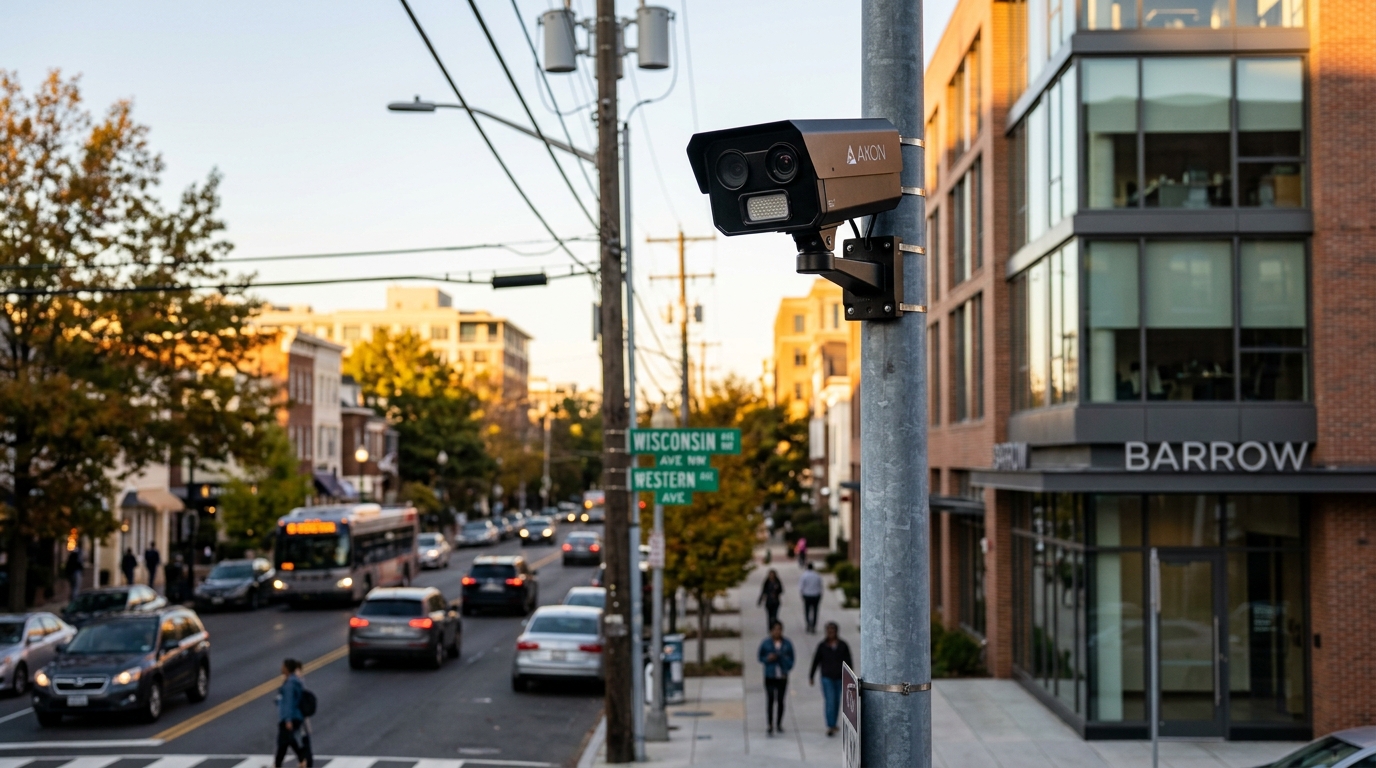
A new set of automatic license plate reader (ALPR) cameras has been installed in the bustling Friendship Heights neighborhood, specifically near the Barrow building. The appearance of these high-tech surveillance tools has quickly caught the attention of local residents, raising questions about their purpose, the technology behind them, and what they mean for privacy and public safety in the District. These cameras, visible on poles, are part of a growing trend in urban areas to deploy advanced technology to monitor vehicle traffic. While the precise details of their deployment in Friendship Heights haven't been officially announced, a local resident submitted observations to PoPville, indicating that these installations might signal a shift in the type of surveillance technology being used by cities. The resident noted that cities appear to be transitioning from systems like Flock Safety to those offered by companies such as Axon.
As the conversation around these new cameras continues, Friendship Heights residents and the wider DC community will be watching for official statements from the Metropolitan Police Department or the Mayor's office. Transparency regarding the use, data retention, and oversight of these powerful tools will be key to building trust and ensuring that public safety measures align with community values.
Understanding Automatic License Plate Readers
Automatic License Plate Readers, or ALPRs, are high-speed cameras that automatically capture images of license plates, along with the date, time, and location. This data is then often compared against "hot lists" of vehicles associated with Amber Alerts, stolen cars, or persons of interest in criminal investigations. Law enforcement agencies across the country utilize ALPRs as a tool to aid in crime prevention, investigation, and recovery of stolen property. The technology can rapidly scan thousands of plates per minute, far exceeding what human officers can achieve. This efficiency is often cited by proponents as a major benefit for public safety, allowing police to quickly identify and track vehicles linked to criminal activity. However, the widespread deployment of ALPRs also brings significant privacy considerations, as they collect vast amounts of data on the movements of ordinary citizens, regardless of whether they are involved in any wrongdoing.ALPRs can scan thousands of license plates per minute, providing law enforcement with rapid data on vehicle movements.
From Flock to Axon? The Shifting Landscape of Surveillance Tech
The observation that cities might be "moving from Flock to Axon" points to a dynamic market in public safety technology. Flock Safety has become a prominent name in the ALPR space, known for its extensive network of cameras in residential areas and business districts. Their systems are often marketed to neighborhood associations and local police departments as a cost-effective way to deter crime and gather evidence. Axon, on the other hand, is a well-established company in law enforcement technology, perhaps best known for its Taser devices and body cameras. Axon's entry into the ALPR market, possibly through acquisitions or new product lines, could signify a consolidation or evolution in how these systems are integrated into broader police operations. Axon's official website outlines its broader suite of public safety solutions, including advanced software platforms for evidence management and real-time operations, suggesting a more integrated approach to surveillance and data handling. You can learn more about their offerings at Axon's corporate site. The shift, if it is indeed happening on a larger scale, could influence data retention policies, access protocols, and the overall governance of ALPR data. For residents, understanding which company's technology is being used can be crucial, as different providers may have varying privacy policies and data security measures.Local Impact in Friendship Heights
For residents of Friendship Heights, a vibrant commercial and residential hub straddling the DC-Maryland line, the presence of these new cameras near the Barrow building adds another layer to the ongoing conversation about urban surveillance. The Barrow building itself is a recognizable landmark in the area, situated amidst retail, dining, and residential properties. The placement suggests an interest in monitoring traffic flow and potentially deterring crime in a high-traffic zone. While the cameras could be seen as a deterrent to vehicle-related crimes, such as carjackings or stolen vehicles, which have been a concern across the DMV, they also raise questions about data collection and civil liberties. Residents might wonder who has access to the data, how long it's stored, and under what circumstances it can be used. The Metropolitan Police Department (MPD) regularly uses various surveillance technologies, and the addition of new ALPRs expands their reach. Information on MPD's general policies can often be found on the District of Columbia government website. The District of Columbia has specific regulations and oversight mechanisms for surveillance technology. Residents concerned about privacy and the deployment of such systems often look to local government bodies, like the DC Council, to ensure transparency and accountability. The Mayor's office and relevant council committees are typically involved in setting policies for public safety technology. As these new cameras become a permanent fixture in Friendship Heights, the community will likely seek more information from city officials regarding their operational guidelines and the impact on daily life. It's a reminder that as technology advances, so too must the public dialogue about balancing security with individual rights.📍 Local Resources
DC Office of the Attorney General - Consumer Protection
Provides resources and takes complaints related to consumer privacy and data security issues within the District.
📞 Phone: (202) 442-9828
🌐 Website: oag.dc.gov/consumer-protection
📍 Location: 441 4th St NW, Washington, DC 20001
🕐 Hours: Mon-Fri 9am-5pm
ACLU of the District of Columbia
Advocates for civil liberties and rights, including privacy concerns related to government surveillance technology.
📞 Phone: (202) 457-0800
🌐 Website: acludc.org
📍 Location: 915 15th St NW, Washington, DC 20005
🕐 Hours: Mon-Fri 9am-5pm
DC Council - Committee on Public Safety and the Judiciary
Oversees public safety agencies and legislation, including policies on surveillance technology. Residents can contact their councilmember to express concerns.
🌐 Website: dccouncil.gov/committees/public-safety
Advertisement
Explore more on this topic
Related Stories
Community
Virginia Mom Channels Grief into Lifesaving Seatbelt Advocacy for Teens
Arlington County·Community
A Virginia
3 days ago4 min read

Community
Maryland Bakery Rebrands, Expands Training for Adults with Disabilities
Montgomery County·Community
3 days ago4 min read
Community
Dupont Circle Braces for Annual 'Epic' Rummage Sale at St. Margaret's Episcopal Church This Saturday
Community
St. Margaret's Episcopal Church in Dupont Circle is holding its "epic" annual rummage sale this Saturday, October 17. The one-day event promises clothing, jewelry, housewares, and more, with all proceeds supporting church ministries and donations benefiting local nonprofits like Charlie's Place.
3 days ago4 min read