Proposed Federal Data Privacy Bill Seeks to Override State Laws, Limit Individual Lawsuits for DMV Residents
Share this article
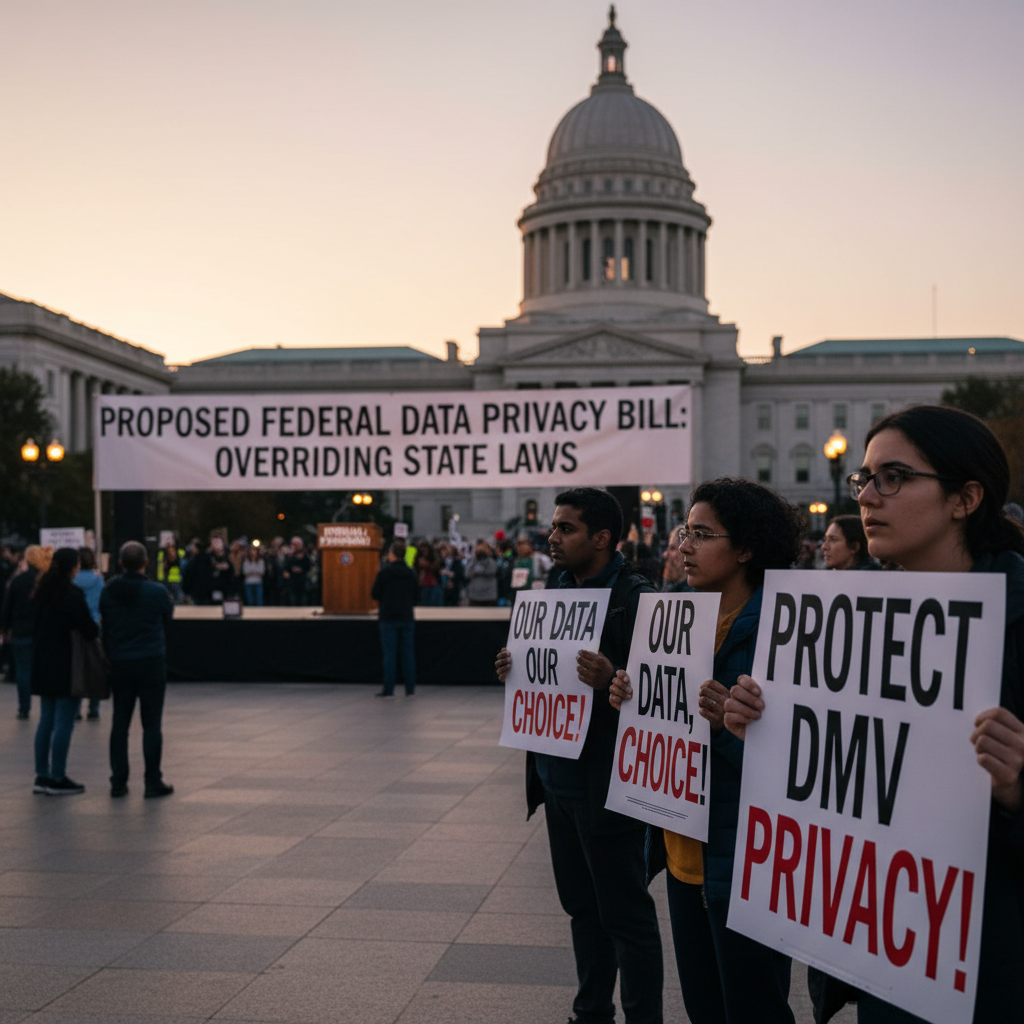
A significant legislative effort is underway in Congress, with lawmakers introducing a pair of bills aimed at establishing a sweeping national standard for data privacy. This proposed legislation, if enacted, promises to dramatically reshape how personal data is handled across the United States, carrying particular implications for residents and businesses within the Washington, D.C. metropolitan area.
The core of this congressional push centers on creating a uniform framework, a single set of rules that would govern how companies collect, use, and protect the digital information of individuals. As reported by CNBC[1], this national standard is intended to streamline compliance for businesses operating across state lines, offering a clear, consistent regulatory environment.
Preemption of State Authority
One of the most impactful provisions within these proposed bills is their intent to preempt, or override, existing state-level data privacy laws[1]. Currently, states like California, Virginia, and Colorado have enacted their own distinct privacy statutes, creating a patchwork of regulations that businesses must navigate. For companies with a presence in the DMV, which often spans Washington, D.C., Maryland, and Virginia, this complexity can be considerable. The federal legislation aims to replace this fragmented landscape with a singular, overarching mandate.
While proponents argue that a national standard could foster innovation and reduce the burden on businesses, critics often voice concerns about the potential weakening of consumer protections. If a state's current privacy law offers more robust safeguards than the new federal standard, those stronger protections could be nullified. This tension between uniformity and comprehensive individual rights lies at the heart of the debate.
Limiting Individual Recourse
Perhaps the most contentious aspect of the proposed legislation is a provision that would prevent individuals from suing companies over data privacy violations[1]. This element, if it becomes law, would fundamentally alter the avenues available for consumers seeking redress when their personal data is mishandled or compromised. Instead of a private right of action, enforcement would likely fall primarily to federal agencies, such as the Federal Trade Commission (FTC).
For residents of Washington, D.C., Maryland, and Virginia, this shift could mean a significant change in how they experience digital privacy. Without the ability to pursue legal action directly, individuals would have fewer direct tools to hold companies accountable for breaches or misuse of their data. This could leave many feeling disempowered, relying solely on government bodies to act on their behalf, a process that can often be lengthy and opaque.
Implications for the DMV Region
The Greater Washington metropolitan area is a unique confluence of federal agencies, tech companies, and a highly informed populace. A federal data privacy bill of this magnitude would ripple through every sector. For the numerous tech firms, startups, and contractors in Northern Virginia and Montgomery County that handle vast amounts of sensitive data for both government and private clients, a national standard could simplify compliance, potentially reducing legal costs associated with navigating disparate state laws. However, the elimination of individual lawsuits could also lower the perceived risk of privacy missteps for some entities, shifting the balance of power further towards corporations.
Federal employees, a significant demographic in the DMV, also stand to be affected. Their personal data, handled by government contractors and agencies, would fall under this new national standard, potentially impacting how their information is managed and their ability to seek justice if it is misused. The legislative process for such a bill is often complex, involving extensive hearings and amendments, a journey that can be tracked on platforms like Congress.gov.
The Path Forward
As these bills move through Congress, the debate will inevitably intensify, highlighting the delicate balance between fostering a unified digital economy and safeguarding individual privacy rights. For residents and businesses across Washington, D.C., Maryland, and Virginia, understanding the nuances of this proposed legislation will be crucial, as it could fundamentally reshape their digital interactions and legal protections in the years to come.
📍 Local Resources for Consumer Protection
Investigates and prosecutes consumer fraud and unfair business practices, offering resources for DC residents.
Handles consumer complaints and mediates disputes between consumers and businesses for Maryland residents.
Provides resources and takes complaints from Virginia consumers regarding unfair or deceptive practices.
Explore more on this topic
Related Stories

Councilmember Janeese Lewis George Urges Caution on Waymo Legislation, Citing DC's Jobs Crisis
Ward 4 Councilmember Janeese Lewis George has urged the DC Council to pump the brakes on Waymo legislation this year, warning that rushing autonomous vehicle laws could worsen the city's "jobs crisis" by displacing workers. She emphasizes the need to prioritize safety and worker support alongside technological advancement.

Ousted Board of Appeals Chair Sues Howard County Council, Office of Law
Howard County's ousted Board of Appeals chair has filed a lawsuit against the County Council and the Office of Law, initiating a significant legal challenge within the local government structure. This action highlights internal administrative disputes and brings the county's appointment and oversight processes into public scrutiny.