Arlington Debates Virginia's Congressional Redistricting Referendum: What New Rules Mean for Voters
Share this article
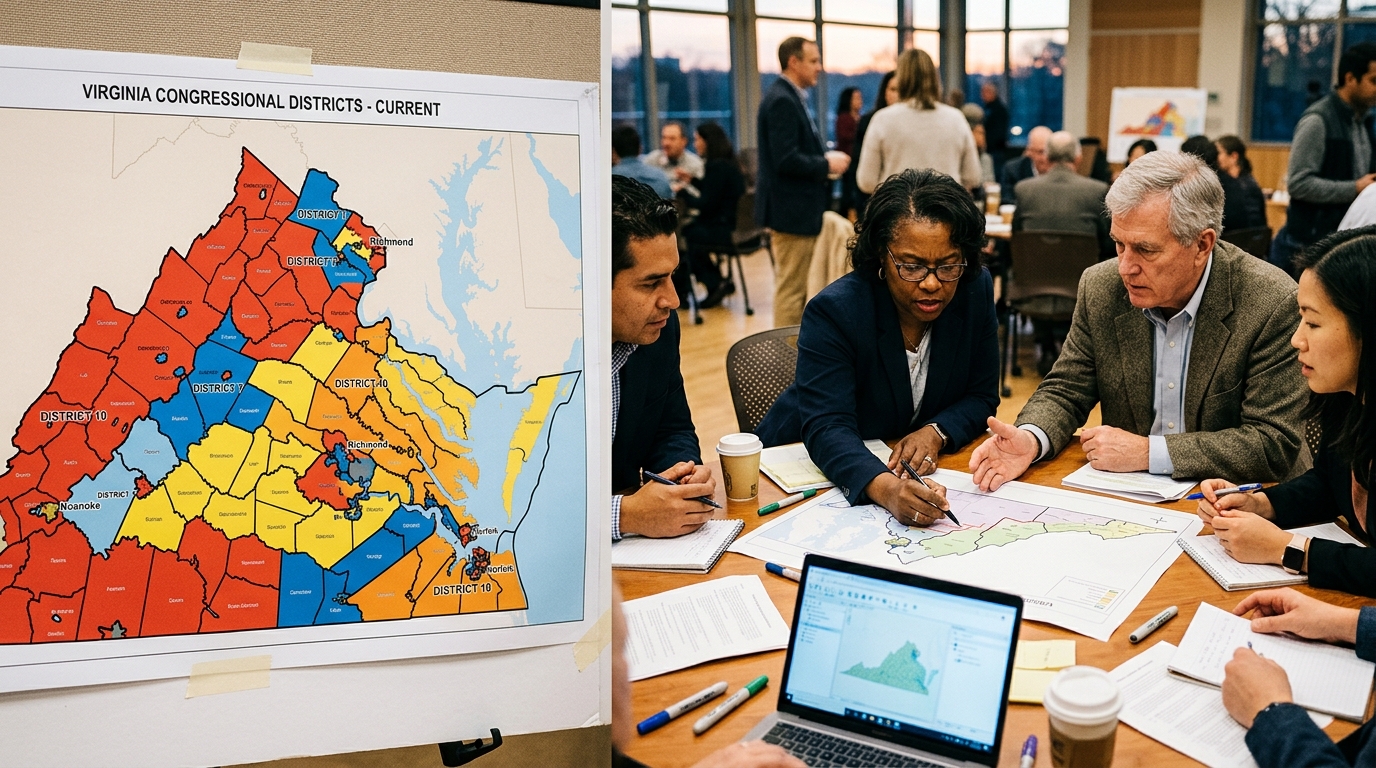
Arlington residents and political observers recently engaged in a lively discussion about Virginia's upcoming congressional redistricting referendum, a critical measure poised to reshape the electoral landscape across the Commonwealth. An April 8 forum, hosted by Advance Arlington, brought together both a proponent and an opponent of the April 21 referendum, highlighting the complex implications of what some are calling "new rules of the game" for how political boundaries are drawn.[1]
The referendum, scheduled for April 21, 2026, aims to alter the process by which Virginia's congressional districts are configured, a topic that consistently generates intense debate due to its direct impact on political representation and election outcomes. Redistricting, the process of redrawing electoral district boundaries, occurs every ten years following the U.S. Census to account for population shifts. In Virginia, this process has historically been managed by the state legislature, but the proposed referendum seeks to introduce a new, more independent approach.
Understanding the Redistricting Referendum
Virginia's redistricting referendum proposes to establish an independent commission to draw the state's congressional and legislative districts. Proponents of such commissions often argue that they reduce partisan gerrymandering, a practice where district lines are manipulated to favor one political party over another. By taking the power out of the hands of partisan lawmakers, these commissions aim to create more competitive districts and ensure fairer representation for all voters. This shift is seen as a move towards greater transparency and accountability in a process that has long been criticized for its opaque nature and potential for political manipulation.
The debate in Arlington underscored the fundamental disagreements surrounding this proposed change. While the source material notes that both an advocate and an opponent found common ground on at least one aspect during the Advance Arlington forum, the broader arguments for and against the referendum reflect deep-seated concerns about political power and voter influence.[1]
Arguments for and Against Independent Commissions
Supporters of the referendum typically emphasize the need to combat gerrymandering, which they argue suppresses voter turnout and leads to unrepresentative outcomes. They contend that an independent commission, composed of non-partisan experts and citizens, would draw districts based on objective criteria such as population equality, compactness, and respect for communities of interest, rather than political advantage. This could lead to districts that better reflect the demographic and political diversity of Virginia's population. For more details on the principles of fair redistricting, the Brennan Center for Justice offers extensive research on the topic.
Conversely, opponents of independent commissions often raise concerns about accountability and potential unintended consequences. They argue that unelected commissioners might lack a deep understanding of local communities and their unique needs. Some also fear that such commissions, while ostensibly non-partisan, could still be influenced by specific interests or lead to outcomes that are less democratic, as the public has less direct recourse with appointed bodies compared to elected officials. The Virginia General Assembly's legislative information system provides context on the current legislative process.
What This Means for Arlington Voters
For residents in Arlington and across Virginia, the April 21 referendum represents a significant moment in the state's political evolution. The way congressional districts are drawn directly affects who represents them in the U.S. House of Representatives, influencing federal policy on everything from infrastructure funding to national security. Similarly, state legislative districts determine representation in the Virginia General Assembly, impacting local issues like education funding, transportation, and environmental regulations.
Understanding the arguments from both sides is crucial for informed participation in this democratic process. The forum sponsored by Advance Arlington provided a platform for these discussions, allowing community members to hear directly from those deeply involved in the debate. As the referendum date approaches, voters are encouraged to research the specifics of the proposal and consider its long-term impact on their representation. Official information about voting in Virginia, including polling locations and ballot details, can be found on the Virginia Department of Elections website.
📍 Local Resources for Arlington Voters
Provides information on voter registration, absentee voting, polling locations, and election results for Arlington County.
Official state resource for all election-related matters, including statewide referendums, voter eligibility, and election laws.